
Heat never disappears and circulates constantly from one body to another and always from hot to cold. Thus, when two materials with different temperatures meet, the hotter of the two gives off calories to the other, more or less quickly depending on their respective nature. Nothing is lost, everything gets transferred. One warms up at the expense of the other, who cools down. These heat exchanges take place through four mechanisms :
- The conduction
- The radiation
- The convection
- The evaporation
The conduction occurs by contact, it’s the hand that heats up against a hot bowl or the foot that cools down on cold ground.
The radiation occurs without contact, it is the heat felt in front of a wood fire or the cold near the cold wall of a window.
The convection is based on an exchange between the body and the air surrounding it, proportional to their temperature difference and the speed of the air’s movement ; it is the heat provided by a fan heater or the cold caused by an air current.
Then evaporation relies on the necessary energy consumption of a liquid to switch to the vapor state, It is the freshness felt thanks to the sprayers and also the perspiration that allows the body to maintain its temperature – its evaporation takes place thanks to the necessary energy drawn from the organism thus cooled.
Added to all, this is our own sensitivity. Some suffering from the heat or cold while others adapt to it. Considering that the perceived temperature is an average between ambient and wall temperatures – walls, windows, floor – so despite an ambient temperature of 22°C, if the wall temperature is only 15°C, the actual perceived temperature will be only 18.5°C. If we know that a difference of just 2° to 3° C between the room temperature and the wall temperature is enough to cause discomfort, and that radiation is more effective than convection for heat exchange, it’s easy to see that it’s always better to focus on the wall temperature.
Humidity finally plays an essential role in thermal comfort because if the thermal comfort zone is between 30% and 70%, the more humid the air, the more air movements are felt, since water is a better conductor than air. Although not considered a pollutant in the strict sense of the word, excess moisture encourages the degradation of materials and the proliferation of micro-organisms such as bacteria, viruses, moulds and insects.
The inertia of materials refers to their ability to store heat. The higher it is, the more the material can store and then release large amounts of heat, and the longer it takes to heat up or cool down because inertia is inseparable from slowness.
A stone wall facing south is a perfect demonstration of inertia. The material is first heated by the sun, its nature making it capable of storing heat, its temperature rises gently. Then there is conduction, because if one side of the material is exposed to radiation, the other is not. Then, the heat undertakes a migration to the heart of the material, from the hottest side to the coldest side. As long as the heat source is not interrupted, the heat migrates until it reaches the opposite side of the material from where it can radiate. When the heat source stops, like when night falls, the warm side of the material faces a drop in outside temperature. A large part of the stored heat then starts a half-turn (heat always moves from hot to cold) causing the material to radiate heat from the side now exposed to the cooler temperature. This is how a stone wall radiates heat in the evening after being exposed to the sun all day long.
The inertia of materials is therefore to dampen temperature variations. During the summer period, the large mass of high-inertia walls allows the sun to store heat until the outside temperature drops again with nightfall. Since the heat does not have time to reach the interior, this is how old houses remain cool in the heart of summer. On the other hand, new buildings have no thermal mass and can only rely on their insulation to protect themselves from rising summer temperatures.
High-inertia materials for creating heavy walls exposed to direct sunlight are stone, concrete, rammed earth, and brick. Materials with medium inertia include aerated concrete or plaster bricks. Whenever possible, it’s helpful to make sure that at least 50% of a room’s walls have good inertia.
Also when solar radiation reaches a surface, one part is absorbed and another reflected, the reflected part being a function of the albedo of the material, that is to say, its ability to reflect. It depends mainly on the color, black reflecting nothing when white reflects everything. To reduce the direct warming of a building, it’s therefore useful to increase the reflected part to reduce the absorbed heat, which is why Mediterranean houses are coated in white lime.
One solution is also to green the soil. Indeed, a dark floor absorbs heat but then releases it at night through radiation, which hinders the essential nighttime cooling in summer. A vegetated soil, with low albedo and reduced nighttime radiation due to its evapotranspiration, can create a difference of more than 10°C between asphalt and a grass-covered soil under the same sunlight.
It is also common to label materials as hot or cold depending on the temperature felt upon contact. For example, to raise their own temperature by 5°C, cork takes 10 minutes, softwood 1 hour and 20 minutes, and tiles 5 hours and 30 minutes. This characteristic is one reason why cork is so widespread in hot countries, covering floors and walls to provide a pleasantly cool feeling
Examples of French innovative products (companies located in the Finistère in Brittany, in Bourgogne near Besançon and in Paris)
https://www.coolroof-france.com/
Heat-resistant paint, who would have thought of that? It’s a great idea to cool down building roofs in cities using a healthy and natural product—oyster shells—to lower the temperature. The idea behind this thermo-reflective paint is to bounce infrared rays back outside, preventing the roof layer from heating up. From there, less energy is absorbed and less heat gets inside the building.
https://www.vieille-materiaux.com/fr/murs-de-facade-en-blocs-de-chanvre-biosys
Facade walls made of hemp blocks
In winter, when you heat your home, the walls store heat like a sponge and then release it back to you.
- If your walls act as a heat reservoir, you heat less
- If you heat less, you pay less
In summer, there are big temperature swings outside. If the walls store heat until the evening, the indoor temperature stays stable and you avoid overheating.
- If the indoor temperature is comfortable, you don’t need to use air conditioning
- If you don’t need air conditioning, you pay less
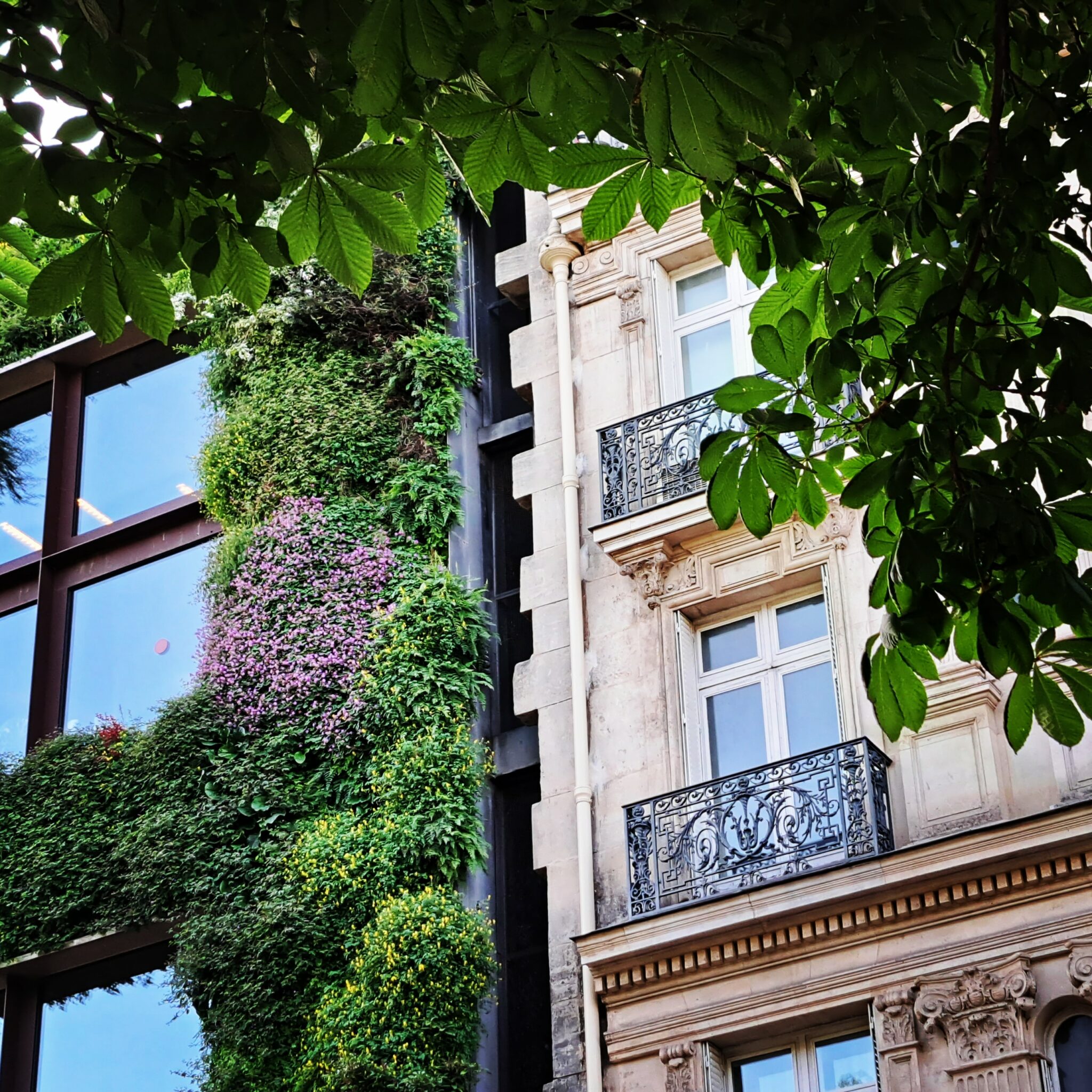
The green agency that reconnects your spaces with nature located in Paris, Bordeaux, Lyon, Cannes