
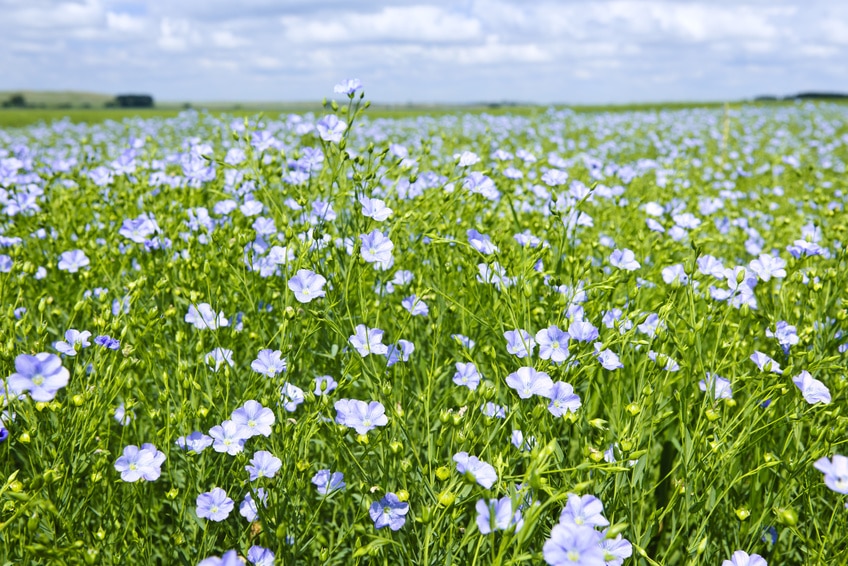
Flax is one of the oldest textile fibers domesticated by humans, dating back to the Neolithic, around 8000 BC. In France, archaeological evidence goes back to the 6th millennium. The ancient history of flax production in Normandy shows a know-how rooted in the local area, making this region the world’s leading flax producer.
In Normandy, flax cultivation has been thriving since the 13th century, particularly in Seine-Maritime. In the Middle Ages and during the Renaissance, flax was used to make sheets, clothing, canvas, and even the famous Bayeux Tapestry, dating from the 11th century which France owns. It was embroidered on a linen cloth and depicts the conquest of England in 1066 by William the Conqueror, Duke of Normandy. For now, it’s supposed to be loaned to England at the British Museum for 10 months (September 2026 to June 2027), which some consider like a “heritage crime” because even though it’s admirably preserved, one can legitimately wonder if the high-intensity vibrations from transport by boat, plane, train, or car might accelerate its deterioration …….. And even assuming it survives such a trip there, what about the way back? What kind of oversight and care will the French, who own this historic painting, be able to provide once it’s on English soil?
But let’s go back to this amazing bio-based material that is flax and its fantastic insulating powers, used in the form of panels, rolls, or mats for insulating walls, roofs, attics, and floors. It helps slow down temperature changes and offers excellent summer comfort, absorbing heat during the day and releasing it slowly. When faced with humidity, its hollow fibers trap air and help provide excellent water vapor permeability. It can absorb up to 10 times more water than glass wool without losing its thermal performance. This makes it a perfect breathable material for renovating old buildings, helping limit condensation. Also, its elastic and dense fibrous structure absorbs sound waves, reduces vibrations and airborne noise, cutting them down by up to 46 dB. It has a long lifespan and if treated, resists rodents and mold.
Linen production is renewable and recyclable, and uses a lot less water than its buddy cotton. However, it’s flammable (class E) without a fire-retardant treatment, which is why having the right covering is important. It’s a bit pricier, but its qualities are such that there’s really no need to think twice. Choosing linen is a no-brainer when renovating. Also, this Blue Gold is rightly celebrated in Normandy with the Linen Festival in Doudeville, the Linen Bike Route, and the Linen Houses in Routot or Amfreville-les-Champs.